Core Takeaway
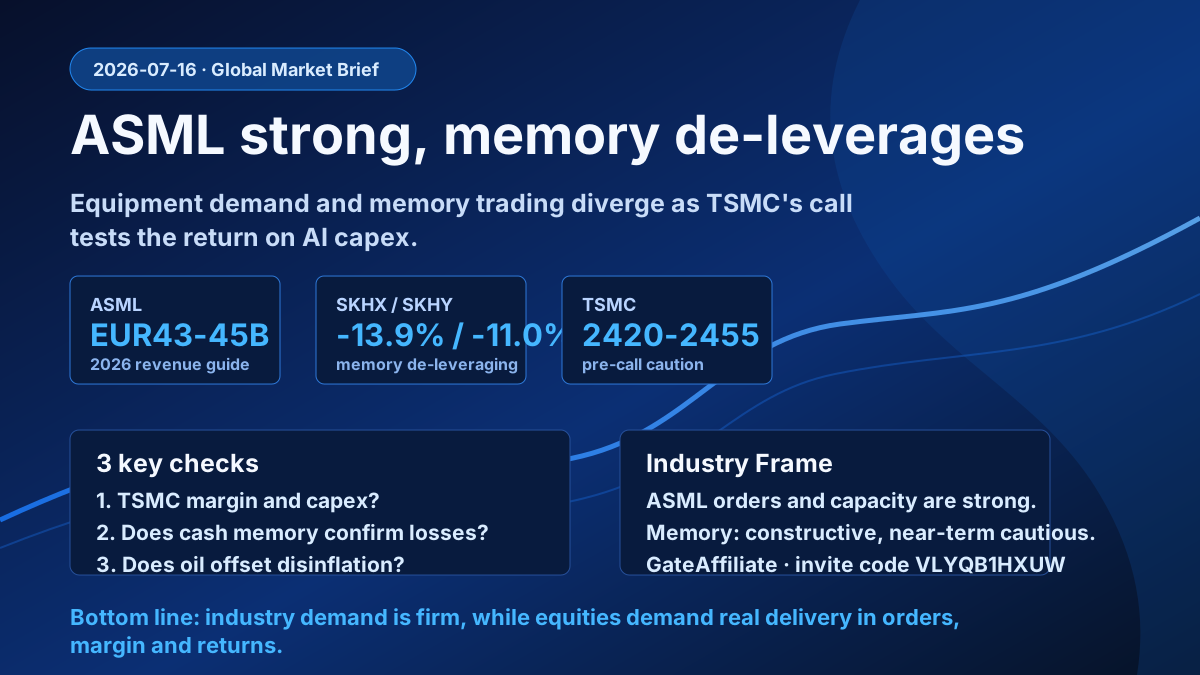
ASML confirms AI equipment demand is still accelerating. Second-quarter revenue reached EUR9.326 billion, gross margin 54.0% and net income EUR2.918 billion, while 2026 revenue guidance rose to EUR43-45 billion. Equipment orders and capacity plans support the AI capex cycle.
Taiwan is nearly flat before TSMC's call while memory contracts suffer another double-digit drawdown. With the SP500 contract slightly positive, this looks like internal de-leveraging in an overcrowded sector rather than system-wide U.S. equity risk.
Industry Strength, Trading Weakness
Memory volatility widened again: SKHX fell 13.90%, SKHY 11.01%, DRAM 11.05%, MU 10.15% and SNDK 11.59%. NVDA eased only modestly, concentrating the selling in the previously more crowded memory trade.
U.S. CPI and PPI both cooled, supporting technology valuations, but WTI remains near $79 and July's energy shock is absent from those releases. Energy-importing markets such as Taiwan and Korea remain sensitive to oil, currencies and policy rates.
ASML plans to raise both low-NA EUV and immersion DUV capacity by about 30% in 2027. That improves demand visibility but creates a tail risk of excess supply in 2027-2028 if cloud returns or memory prices weaken.
Trading Frame
For TSMC's call, prioritize the combination of full-year U.S.-dollar revenue growth, gross margin and capex, followed by 2nm / 3nm utilization, CoWoS expansion and overseas-fab costs. Higher capex with lower margin would deepen return dispersion across the chain.
At the U.S. open, watch ASML's earnings reaction and validate TraderXYZ through MU, SKHY and SNDK cash shares, SOXX / SMH and options. Much smaller cash losses would imply leverage and liquidity discounts in perpetuals.
Keep watching Brent and U.S. yields. Stay constructive on memory medium term but cautious short term, using orders, pricing, volume and options skew together for confirmation.